

The Best Players in the World Still Need a Coach
Cover: K on Pexels
Why enterprise AI needs an All-22 view of the business
Imagine an NFL owner with unlimited money. He assembles the best quarterback in football, the fastest running backs, the strongest offensive line, and the most talented defense. Every position is filled by someone exceptional. The franchise has the resources to recruit, train, and equip its players as well as anyone in the league. And somehow, the team keeps losing. The owner could spend another hundred million dollars acquiring better players, but eventually he'd have to ask whether the problem has anything to do with the players at all. Perhaps what he needs is a better coach.
Large enterprises face a similar challenge. They've assembled extraordinary collections of specialized technology: financial systems, supply chain platforms, geographic information systems, data warehouses, analytics tools, and operational applications. Each has been selected to do a particular job, and many do that job exceptionally well. The people using them know their systems, and the organization has invested heavily in making them productive. Yet when a question crosses departmental or technological boundaries, all that individual excellence doesn't necessarily add up to a good answer.
For a small, growing business, the proposition is different. It doesn't have a deep bench of specialists or the budget to build one. Technology that gives a handful of people the capabilities of a much larger organization can change what that company is able to accomplish. It's the dream of fielding a star quarterback who can cover an extraordinary amount of ground. A large enterprise already has its roster, along with commitments to the systems and people behind it. Asking that organization to replace its players is a difficult proposition, even when the replacement looks impressive on paper.
AI makes this distinction more consequential. We're becoming comfortable asking questions about almost anything, and we'll increasingly ask questions we never would have thought to ask. Those questions always had potential value, but answering them could require too many people, too many systems, and too much time. One answer will naturally lead to another. We'll test possibilities, change assumptions, and ask what happens next. The ease of asking is advancing faster than most organizations' ability to respond with reliable answers grounded in their own operations.
Consider a hurricane approaching the Gulf Coast. An energy company might ask which facilities are at risk, which suppliers could be affected, what transportation routes might close, and which customers would feel the consequences. Then the forecast shifts. What if the storm turns east? What if a supplier loses power? What if production is moved to another facility? The answers depend on information held across different systems and outside providers, as well as the relationships between physical assets, people, locations, and events. Each source may be accurate on its own while the complete picture remains difficult to assemble.
This is where the coach becomes a useful way to understand what enterprise AI needs. A great coach knows the players, their strengths and weaknesses, and the combinations that work. He understands the plan and how to change it when conditions change. He remembers what happened in the last game, which decisions succeeded and which failed, and what the team can learn from the result. The value of that knowledge grows with experience. The coach makes the specialists more effective together.
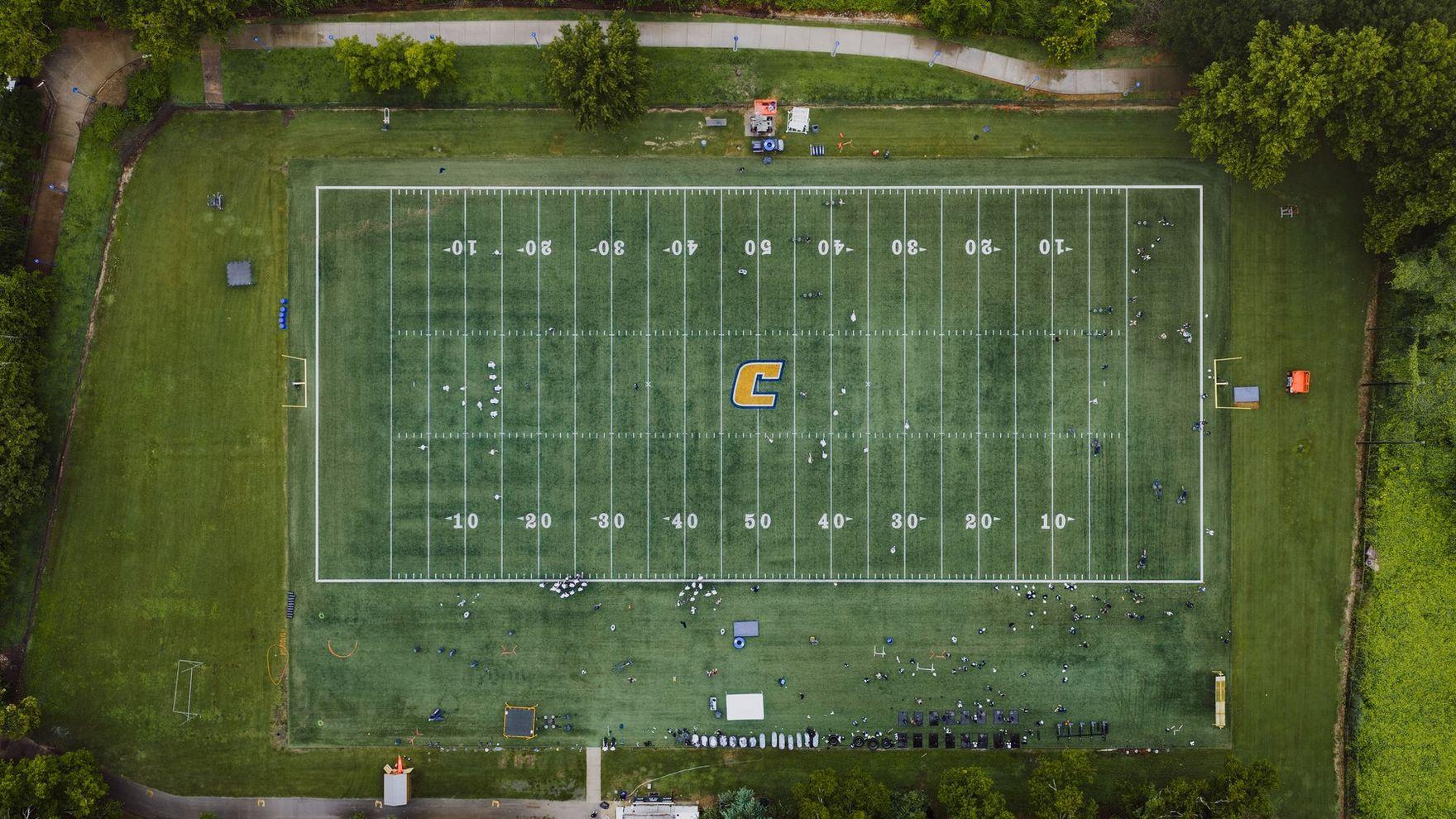
There's a reason NFL coaches don't rely on the regular television broadcast when reviewing a game. They use what's called All-22 film, a view that captures all 22 players on the field. The television broadcast follows the ball and the action around it. All-22 lets coaches study the entire formation: the routes developing away from the ball, the defensive coverage, the blocking assignments, and the spaces that open or close. A play that looks like an individual mistake from one angle may reveal an entirely different story when you can see everyone involved.
Most enterprises see themselves through something closer to the television broadcast. Each department or application follows its own part of the action. Reporting structures often reinforce a linear or hierarchical view: this division, this process, this system, this result. But the real business operates through relationships that cut across those boundaries. A supplier depends on a transportation route; the route depends on infrastructure and weather; a facility depends on both; and a decision in one part of the organization can change the outcome somewhere else. Understanding those connections requires a 360-degree view of the enterprise.
The All-22 perspective is only part of what makes a coach valuable. The film doesn't decide what to do next. The coach interprets it, connects it to previous games, recognizes patterns, and develops a strategy. Imagine making that kind of understanding available throughout an organization. Someone in operations could ask how a disruption affects customers. Someone in finance could ask about the cost of alternative responses. An AI agent could examine a different scenario without reconstructing the business from scratch. They would be working from a shared picture of the same organization, informed by its history and the changing conditions around it.
The technology behind that shared picture has a formidable vocabulary: semantic layers, ontologies, knowledge graphs, data federation, provenance, governance, entity resolution, and spatiotemporal computation. Those terms describe different parts of the machinery. Together, they help establish what information means, how entities and events relate, where information came from, who can use it, and how relationships change across place and time. The names matter to the people building the technology. To everyone else, the objective is straightforward: give the business a coherent understanding of itself, available whenever a new question arises.
At SeerAI, we've brought these capabilities together in Geodesic. Its semantic layer is designed to connect information and meaning across existing systems, making a more complete operational view possible without requiring an enterprise to rebuild everything it already owns. The same architecture can serve two very different organizations. For a smaller company, Geodesic can be the star quarterback, providing capabilities a lean team could never afford to assemble individually. For a large enterprise, it can be the scalable coach, drawing on the strengths of the existing roster, preserving what the organization learns, and helping people and AI agents make decisions with a view of the whole field.
The economic implications are different but equally compelling. A growing company can expand its capabilities without taking on the cost and complexity of a much larger organization. An established enterprise can get more from the systems, people, and expertise it already owns. Better visibility may reveal duplicated work, overlooked dependencies, or opportunities to simplify technology over time. More importantly, each new question can build on a shared understanding rather than beginning another disconnected integration exercise. The organization becomes better at using what it knows.
This is why we see an emerging category of enterprise software taking shape: an operational knowledge layer. As AI makes it natural to ask more questions, explore more possibilities, and expect answers that reflect the real world, the ability to understand the enterprise as a whole becomes increasingly valuable. Even an infinitely wealthy football team can assemble the best players and still struggle to win. Eventually, it recognizes that the next advantage may come from how the team sees, learns, and works together. It's not about replacing the team. It's about helping the team see the whole field.
See it on your own data.
Book a demo