

Protocols
As the dust begins to settle on LLMs and the real work of structural AI begins in earnest, it’s becoming clear that communication protocols will define the next phase of development.
This shouldn’t surprise us. Historically, the reach and value of any new technology has depended less on the novelty of the thing itself and more on its ability to communicate, to integrate, with what already exists.
HTTP enabled data transfer between web pages. I2C allowed hardware components to speak at the device level. SMTP made email interoperable. Each protocol took isolated instantiations of a technology and connected them. In doing so, they formed the infrastructure for an ecosystem where far greater value could emerge.
We are at a similar moment with AI.
Emerging protocols now allow AI agents running on LLMs to access tools and to communicate with one another. Model Context Protocols (MCPs) provide a bridge between agents and the systems around them: tools, databases, APIs. They give agents the ability to act.
Agent-to-Agent (A2A) protocols allow agents themselves to coordinate, regardless of the framework they were built on. What was once an isolated, impressive demo becomes an AI worker participating in a broader ecosystem of other AI workers collaborating, delegating, and completing shared tasks much as human colleagues do.
So where does SeerAI fit into this emerging ecosystem?
Like many SaaS platforms, we provide an MCP server that allows authorized agents to use the utilities available in our Geodesic platform. But there is a deeper level to that.
Beneath the agent layer sits something more fundamental: data.
The purpose of data is to represent, as faithfully as possible, something in the real world; an event, a transaction, a location, a person, a thing. To do that, reality must be digitally encoded and stored in some structured form. But different aspects of reality are encoded differently. Sales data may live as a CSV and appear as a table. Satellite imagery may be stored as a PNG and rendered as pixels. Sensor feeds, vector geometries, time series. Each has its own format and logic.
Before SeerAI, these data types did not communicate. Not really. Integrating them required brittle pipelines and square-peg-to-round-hole transformations. It was custom glue code masquerading as architecture.
What SeerAI and our Geodesic platform provides is a communication protocol for data itself; a lingua franca that allows disparate data types to interoperate without losing their structure or meaning. In that sense, we are not merely another tool in the AI ecosystem. We operate at a more primitive layer.
A2A enables agents to speak to one another. MCP enables agents to use tools. Geodesic enables data to speak to data.
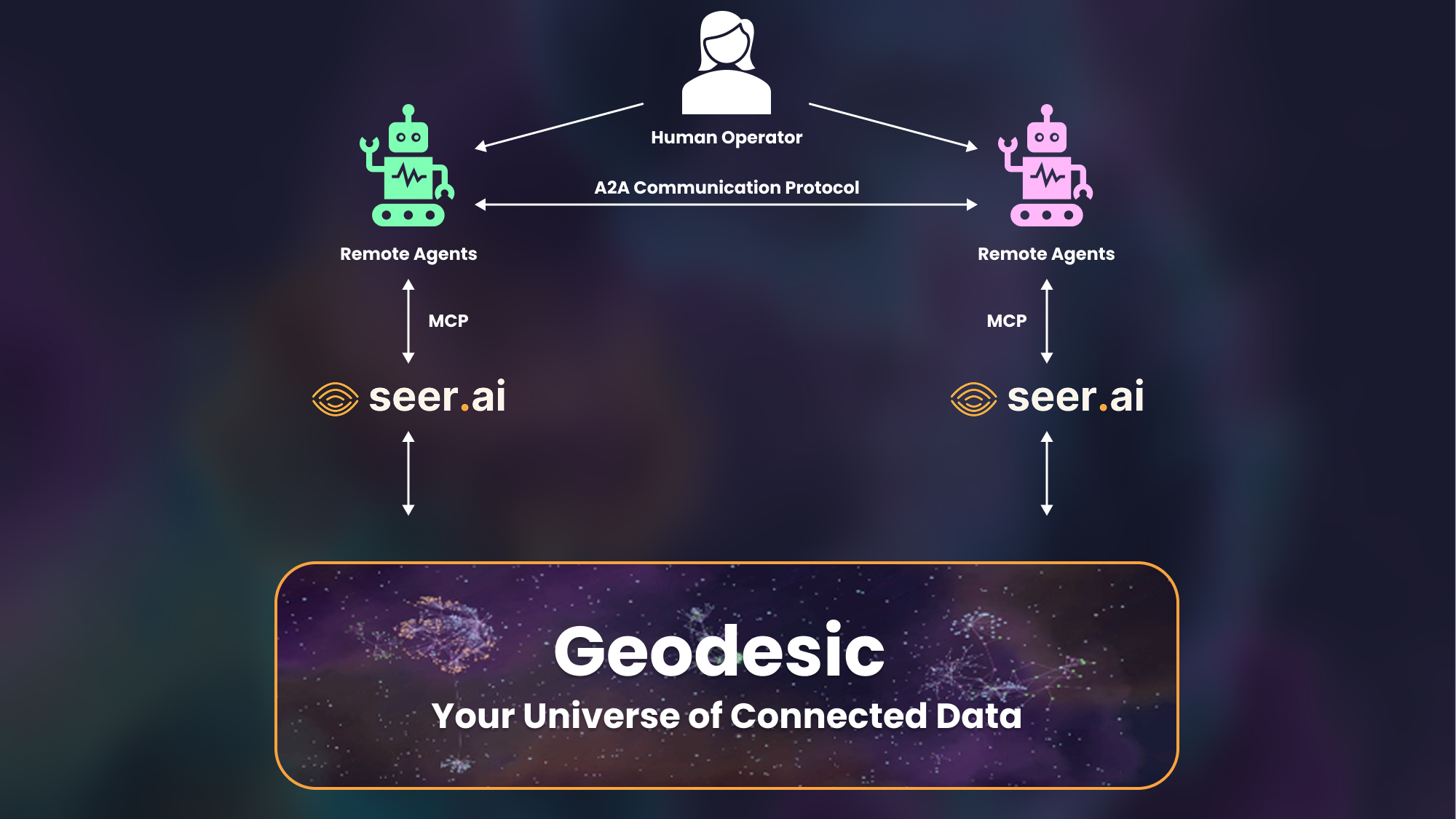
That is what we mean by infrastructure. We make it possible for the atomic unit of the entire system, namely data, to share a common language. Once that layer is coherent, everything above it - agents, workflows, orchestration - becomes architecture rather than acrobatics.